
Through the end of the third quarter of 2025, the Dow Jones Industrial gained 9.1%, the Standard & Poor’s 500 Index added 13.7% and the Nasdaq Composite advanced 17.3%. The equity markets seem to have forgotten the extreme volatility of the second quarter when President Trump imposed a baseline 10% tariff and reciprocal tariffs of up to 50% on dozens of trading partners, only to suspend most reciprocal tariffs for 90 days amid market panic. The S&P 500 Index lost 19% over the next month. When China and the U.S. de-escalated from extreme retaliatory measures in mid-May, the markets recovered and hit new records. Wall Street coined a term for dealing with the headline tariff threats: the TACO trade, an acronym for “Trump Always Chickens Out.” Today, the “wall of worry” that creates the conditions for a sustainable bull market seems to have been replaced by Alfred E. Neuman’s attitude of “What, me worry?” We do worry, especially when it seems that few others are worrying. A few things that we are currently thinking about are valuations, complacency, China and tariffs.
First let us discuss equity valuations. We will acknowledge that equity valuation is a near useless tool for predicting near-term stock returns, but it is a useful indicator for longer-range expectations of equity returns. At the end of the third quarter, the S&P 500 Index was trading at 22.8x forward earnings, a P/E ratio that is 36% higher than the 1996-2025 average. The current dividend yield is 1.5%, a 25% discount to the 30-year average. Exhibit 1 shows two charts from JP Morgan’s Guide to the Markets.
Exhibit 1
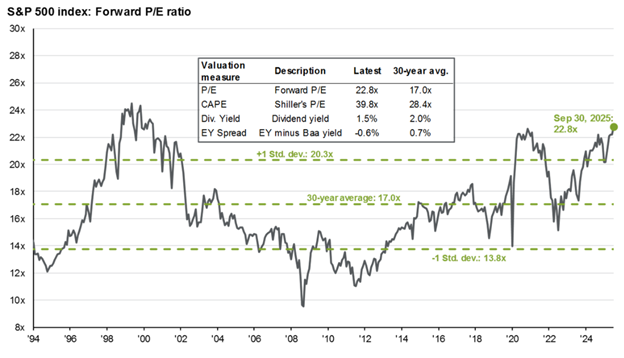
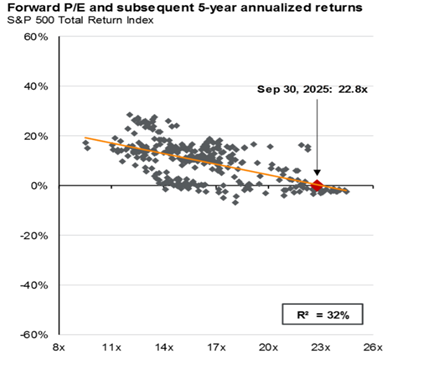
The first shows current versus 30-year average S&P valuation based on four different metrics. The second shows forward P/E levels tracked against performance over the next five years. This chart suggests that future returns from the current forward P/E valuation are not strong historically. A further note, two of the three diamonds above and to the left of the current reading are from the strong S&P performance in 2023 and 2024. Exhibit 2 shows the Buffett Indicator.
Exhibit 2
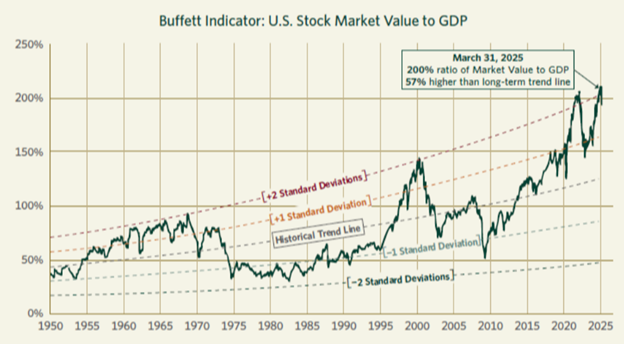
The Buffett Indicator is the ratio of total U.S. stock market capitalization to the country's Gross Domestic Product (GDP). Warren Buffett popularized it, calling it "probably the best single measure of where valuations stand at any given moment" in a 2001 Fortune article. The argument can be made that in 2001 there were few giant companies that were held outside of public markets, and today there are many, but an indicator reading of over 200% convinces us that the market is not cheap. The market is also more concentrated than anytime over the last 50 years. Of the ten largest companies by market capitalization in the S&P 500, only two are not mega-technology names (Berkshire Hathaway and JP Morgan). The market capitalization weighting of the ten largest names in the S&P 500 was 40.4%, while the earnings share of the top ten was 32.5%. To be fair, the big tech names are generating above-average earnings growth, but the nature of their businesses has changed. Which brings us to complacency.
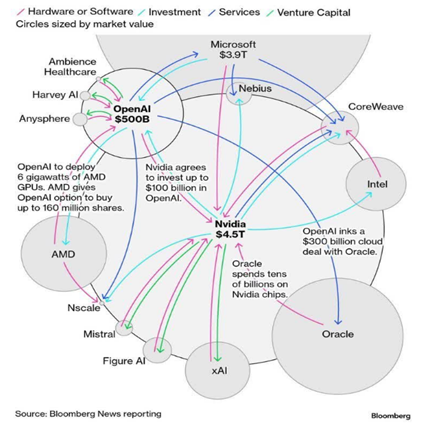
Every economic and investing decision involves trade-offs. Complacency arises when trade-offs are ignored. For many years, the largest technology companies (Microsoft, Amazon, Alphabet and Meta) operated asset-light business models generating copious amounts of free cash flow that could be utilized for internal growth investment opportunities, synergistic or diversifying acquisitions and share repurchases. When those companies embraced the pursuit of artificial intelligence (AI), the business model became much more capital intensive. Twenty years ago, these hyper-scalers spent 10% of operating cash flows on capital expenditures. Ten years ago, they spent 20%. JP Morgan estimates that they will spend over 60% of operating cash flows on capital expenditures this year. Bank of America Research, adding Oracle to the list of hyper-scalers, estimates that the five companies spent 72% of operating cash flow in the second quarter of 2025. Morgan Stanley estimates that a $2.9 trillion investment will be needed to effectuate the plans of the hyper-scalers through 2028, and only $1.4 trillion of that can be funded with internal cash flows from the companies. The bank estimates that the rest will need to be financed with some combination of private credit, corporate debt, asset-backed securities and sovereign financings, mostly secured with liens on datacenters and chips. That seems a little circuitous at this point, given the revenues that AI currently generates, but that is the plan. Another huge trade-off of an AI dominated future is a huge increase in electricity costs and electric infrastructure investment. Residential consumers will not like that. And speaking of circuitous, some of the largest AI players are now entering co-investing schemes that seem a bit suspect (Exhibit 3). For instance, Nvidia invests $100 billion in OpenAI who uses the money to sign a datacenter contract with Oracle who then buys chips from Nvidia. We saw financings like this 25 years ago during the late-1990s tech bubble—it did not end well.
Exhibit 3
The market seems complacent. As China and President Trump spar publicly about retaliatory tariff rates and rare earth minerals, people seem to have forgotten the challenge to the Executive over the power to set tariffs at all. President Trump invoked the International Emergency Economic Powers Act to declare the tariffs, while bypassing Congress. The U.S. Court of International Trade already declared the move unconstitutional because the IEEPA does not specifically delegate tariffing power to the Executive, while the Constitution specifically does describe the Legislature’s role. The Supreme Court appeal is already accepted, and arguments will happen soon. Revoking the tariffs as unconstitutional could cause a huge mess. Other signs of complacency are meme stocks, the return of SPACs (special purpose acquisition companies) to buy cryptocurrencies, loan frauds committed on Zions Bank and Western Alliance, and the recent bankruptcies of First brands Group (factoring fraud) and Tricolor Holdings, which made used car loans to undocumented aliens. In the face of this, we are reducing exposures to expensive equities and adding to fixed income positions.